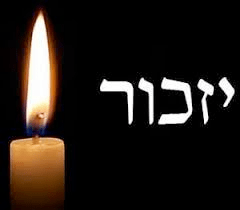
Today was Yom Kippur. As usual, I spent most of the day in synagogue, praying for forgiveness and a good year.
It’s now 1 AM, and I’m wide awake. I suspect that the hour-long nap between services, as well as the 2 cups of fully caffeinated coffee I had at 8 PM with my bagel, are to blame. But in these quiet hours, after a full day of prayer and introspection, I have continued the reflection and contemplation that marks Yom Kippur. And these thoughts revolve around Yizkor.
The Yizkor Service is a brief prayer service (about 20 minutes) that Jews recite on Yom Kippur. The service is recited on Passover, Shavuot, and Sukkot as well, but if people attend one service, it’s the Yom Kippur one, probably because we are all in synagogue anyway. Many Jews never attend another service during the year but make it a point to attend Yizkor on Yom Kippur. The service is usually packed.
What is Yizkor? Yizkor means to remember. In a nutshell, it is a memorial service where we remember our relatives who are no longer with us on earth.
Yizkor can be recited in memory of any Jew who has passed on. However, traditionally, Jews recite Yizkor in memory of a first-degree relative—parent, spouse, sibling, or child. Furthermore, there is a custom that if both of your parents are living, you deliberately do NOT participate in the service—that is, you leave the sanctuary during the service, and return when it is over. It’s a superstition—you are tempting fate by staying for Yizkor while your parents are still living. For this reason, often you see a mass exodus of young people from services when the rabbi utters the words, “Please turn to page xx for the start of the Yizkor Service.”
Since both of my parents are still living, I leave the sanctuary, even to this day. So clearly it’s worked for me so far!
Some rabbis do not particularly like this mass exodus. In fact, over the years, I have heard rabbis begging people to stay for the Yizkor Service, to recite Yizkor in particular for Jews who perished during the Holocaust and have no one to recite Yizkor on their behalf. And usually, those pleas from the bimah are ignored, as tradition and superstition carry more weight than the rabbi’s pleas to remain.
My mother, tragically, started reciting Yizkor when she was only 24 years old. My father didn’t recite Yizkor until much later, when he was in his 40s. When I was a child, Junior Congregation Services were often scheduled to coincide with Yizkor, so I didn’t really know what was going on, except that if services were running long and Yizkor was not over by the end of Junior Congregation, I had to wait a few minutes before I could join my parents in the “big” service. If I happened to be in the adult service when Yizkor started, my mother would send me out of the sanctuary with my father. By the time my siblings and I were exhorted leave services on our own, we were more than happy to do so. It was a “get out of services free” card, for at least a little while. Yet the whole thing was shrouded in mystery, as it was clearly “adults only.” What were they doing in there?
Years ago, when I joined my own synagogue, I would leave the service with Evan, and we would stand in the lobby outside the sanctuary and chat with our friends who also did not participate. It was a bit of a social scene, with all the 20-somethings and 30-somethings catching up, while the older folks were praying.
Over the years, of course, my friends began losing their parents and no longer joined the mass exodus. In 2012, Evan joined them. For the past 10 years, I have been leaving the service on my own, chatting with the few remaining among my friends who hadn’t yet joined the “club” that no one wants to be a member of.
As usual, today, when Yizkor began, I left the service accompanied by my son. As usual, I looked for my friends, my contemporaries, who still did not need to attend Yizkor. There were 3 of us, in total.
All three of us have parents in, or approaching, their 90s. In all of our cases, our parents are very close by—either in the same town, or a few towns over. They are all still living independently, though we all lend them a hand when necessary. We all know how fortunate we are.
Because of COVID, our synagogue did not have in-person Yom Kippur services in 2020. In 2021, services were hybrid, and many people chose to observe at home. Therefore, this was the first time in 3 years that Yom Kippur services had a more traditional feel to them, with large numbers of in-person attendees. Therefore, the loss of our friends’ parents was even more jarring, since it seemed to come on suddenly.
The three of us in the lobby looked at each other. We realized it was just the three of us now. For me, that was a bit of a wakeup call. It was a wakeup call that I want my children to stay out of that Yizkor Service for as long as they can. I want my children to be one of the last of their friends to join the club that no one wants to join.
So, on this Yom Kippur day after the sun went down, after I listened to the shofar blast ending the fast, I realized that I will do WHATEVER I need to do to keep my children out of that service. Even if it scares me. I will take that on, FOR THEM.
That means I am coming around to accept that I will undergo the surgery and remove my breasts, thereby reducing my risk of breast cancer from up to 87% to less than 5%.
This decision is not quite as sudden as it seems. Back in August I met with a breast surgeon and a breast reconstruction surgeon at Memorial Sloan Kettering. We determined, based on my health history and body, what options were available to me in terms of both mastectomy and reconstruction. I’m still mulling over all the information I’ve gathered, and nothing is decided—not the procedure, timing, reconstruction, etc. But I have come to accept that this surgery is in my future, and likely sooner rather than later.
 cisforchaya.com